


AI is evolving from a digital tool into a reliable partner within the team. AI-powered 3D avatars make knowledge accessible via natural language, guide people through processes and enable consistent interaction across different media. For this collaboration to succeed, trust, clear responsibilities and digital sovereignty must be considered together right from the start.
A new employee is looking for definitive information on an internal process. Instead of searching through multiple filing systems or waiting a long time for a reply from a colleague, she simply asks the company’s 3D avatar. Let’s call him Paul. Paul replies, explains the context and guides her through the next steps. He is familiar with the approved knowledge bases, takes her role into account and remains approachable even when the interaction shifts from spoken dialogue to a specialist application. What feels like a conversation with an experienced team member is, in fact, collaboration with a Digital Human.
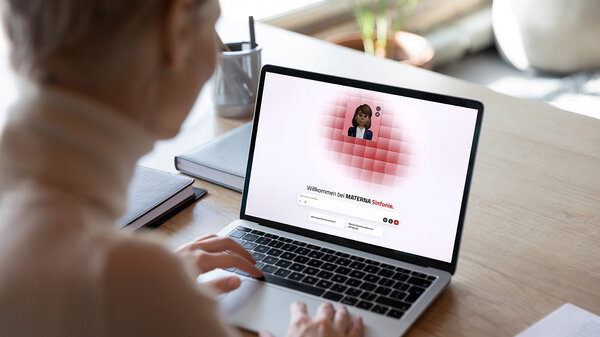
The reason Paul works so well is down to Materna Sinfonie. The modular platform orchestrates a team of subject matter experts and makes generative AI, in the form of digital humans, an intuitive and confident experience. In doing so, Materna combines AI, knowledge management, voice interaction and interactive 3D avatars.
Sinfonie can be operated entirely within an organisation’s controlled infrastructure – from 100 per cent on-premises to European clouds and other cloud environments. Existing knowledge sources, specialist systems and role- and authorisation-based concepts can be integrated. This ensures that data, models and knowledge repositories remain under the organisation’s control, whilst users interact with the assistants or agents via natural language, facial expressions and gestures.
For technical implementation, the solution combines Materna components, open-source technologies and established platforms to form an architecture tailored to the infrastructure, sovereignty requirements and usage scenarios. Engines developed by Materna are available for animation, based either on open-source or NVIDIA technologies such as NVIDIA Audio2Face. Existing knowledge sources are integrated via frameworks, such as Haystack from deepset. Sovereignty is thus not understood as a renunciation of high-performance technology, but as the ability to consciously select architecture, operating models and components.
The development of Sinfonie drew on experience gained from a client project for a regional administration in North Rhine-Westphalia. The focus there was on a practical question: how can staff be supported with queries regarding internal processes, regulations and knowledge bases, whilst simultaneously meeting high standards of data protection, information security and digital sovereignty?
This approach gave rise to a transferable platform for various fields of application. A Digital Human can induction new staff, assist with internal service enquiries, consolidate knowledge from various sources or facilitate access to complex specialist procedures. In doing so, it does not replace human colleagues. Its strength lies in providing recurring guidance, making information accessible and supporting people in situations where searching, switching between systems and navigating complex rules take up time.
Sinfonie is the logical evolution of generative AI. Without a Digital Human, communication between humans and AI takes place in anonymous chat windows, specialist knowledge is scattered across different systems, and each access point has its own set of rules. Digital Humans combine AI, knowledge management, voice dialogue and visual presence. An impersonal input field becomes an interlocutor with a face, who understands language and conveys answers through voice, facial expressions and gestures.
This also changes the role of the assistant. They do not merely answer individual questions, but can guide people through information, internal services and complex specialist processes. During onboarding, they explain structures and regulations tailored to the respective role. In knowledge management, they access distributed content from documents, knowledge repositories and specialist systems. In specialist support, it clarifies interrelationships and helps users identify the next logical step. The decision and responsibility remain with the user; however, the Digital Human reduces the time spent searching, provides guidance and makes existing knowledge accessible when it is needed.
A natural voice and a credible visual identity lower the barrier to use. However, trust is only established when design and system behaviour are aligned. A Digital Human must access authorised knowledge sources in a transparent manner, observe roles and permissions, and provide its responses within the relevant professional context. It must not give the impression that it knows more or is able to make decisions beyond what is actually intended.
Research confirms this. A human-like appearance alone does not build trust. What is crucial is the interplay of credible design, transparent behaviour, reliable information and a clearly defined role. People must be able to understand the basis on which a Digital Human responds, the tasks it undertakes and where its limits lie.
Continuity across different access points is also crucial. People do not think in terms of technical interfaces: they start with a spoken question, then need a document, or switch to a specific process. The digital assistant must adapt to this fluidity whilst remaining recognisable as a consistent point of contact. In doing so, it combines knowledge, language and interaction. Cross-channel therefore does not mean displaying the same avatar everywhere. It means providing reliable assistance via the most appropriate interface in each case – without any breaks in context, authorisations or the quality of information.
Trustworthy human-AI teams therefore need three things: a clear division of tasks, well-founded answers from authorised sources and a transparent operating model. It is only this interplay that transforms an appealing interface into a reliable digital specialist assistant.
The more human an AI application appears, the more important the question becomes of what is happening behind the scenes with data, models and knowledge bases. Public authorities, public IT service providers and regulated companies, in particular, cannot pass on sensitive information to external services without proper control. For them, modern user experiences are only viable if the organisation retains technical and subject-matter control.
The next stage in AI’s development will not be determined solely by larger models. It will depend on whether people trust the interaction, understand their role and remain capable of acting at all times. Digital humans can bridge the gap here:
between powerful AI systems and communication that feels natural
between distributed specialist knowledge and the specific task at hand
between different approaches and a consistent range of support
The benchmark, therefore, is not how human an avatar looks. What matters is how reliably the interaction works. When technical context, clear authorisations, understandable interaction and a robust operational model come together, artificial intelligence becomes a productive partner within the team – present when support is needed, and controllable by the organisation it serves.