


Organisational charts show people, hierarchies, roles and responsibilities. But what if the next member of staff isn’t a human being? What may sound strange at first is becoming a reality for an increasing number of companies. Analysts such as Gartner are already talking about a new era of ‘Agentic AI’ – a digital workforce that not only provides support but acts independently. Instead of passive tools, autonomous AI agents are emerging that take on complex tasks, make decisions and become part of the organisation as a ‘silicon-based workforce’.
The forecasts are clear: by the end of 2026, around 40 per cent of all business applications will incorporate agentic AI – compared with less than five per cent in 2025. And by 2028, as much as 15 per cent of all day-to-day decisions could already be made autonomously by AI. At the same time, studies – including those by Deloitte – show that this transformation presents not only opportunities but also risks: a failure to adapt processes, unclear responsibilities and cultural resistance are among the greatest challenges.
For however profound the technological changes may be, they raise a much more fundamental question: what does this actually do to us as human beings? What role will employees play in future within an organisation where digital colleagues work independently? And what does it mean for companies when not only people but also machines are part of the team?
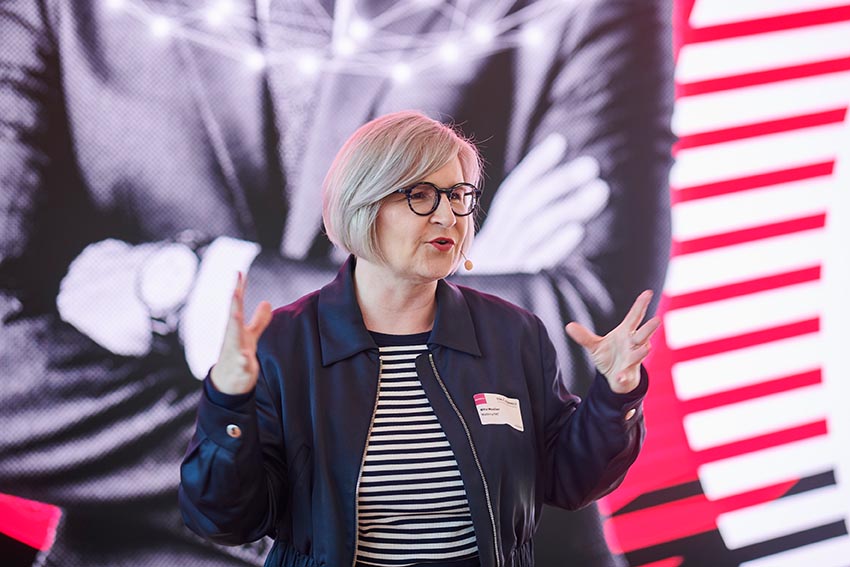
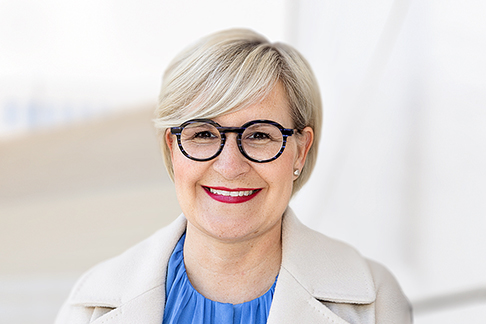
We spoke to Nina Moeller, CEO and transformation expert at Materna TMT, about how companies can integrate AI agents effectively, what role leadership will play in the future – and why the key to success lies not in the technology, but in how we interact with people.
How does the idea that your next colleague might be an AI make you feel?
For many, this idea feels rather strange at first. I myself have been mulling it over for a long time without actually saying it out loud. Yet it is precisely this that has given rise to something exciting: the question of what happens if we don’t just view AI as a tool, but actually treat it like a colleague.
What does that mean in practical terms for your company?
We have actually incorporated AI into our organisational chart – with clearly defined roles, areas of responsibility and full transparency for all staff. It was important to us not to view AI merely as a tool, but as part of our organisation.
That sounds like a radical move. Why did you decide to do this?
Because we realised that if AI is already part of our day-to-day work, then we should make it visible within our organisation too. Anything else would be inconsistent. At the same time, this step forces us to engage more deeply with the question of what collaboration should look like in the future.
What reactions have you seen from staff – have there been any critical voices or resistance?
The reactions vary greatly, ranging from enthusiasm to scepticism and uncertainty. The most common question is quite clearly: ‘Will we be replaced?’ – and that is entirely understandable. The crucial thing is how we, as managers, deal with this. Such concerns must not be played down or dismissed, but must be taken seriously. It was therefore important for us to remain transparent, to listen and to consciously address these emotions. That is precisely what leadership is all about in such change processes.
What exactly does this development mean for leadership?
Leadership is currently undergoing a fundamental transformation. Historically, we have come from a world of control and management. Today, it is much more about providing direction. In future, leaders will be one thing above all else: enablers. They create the conditions in which people – and, increasingly, AI – can work together effectively.
You deliberately talk about collaboration with AI rather than replacement. Why is that?
We are moving towards hybrid teams in which people and AI work together. Studies show that this combination will become the norm. The crucial question is therefore no longer whether this will happen, but how we shape this collaboration.
How will this change organisations?
The implications are significant. The traditional pyramid structure with many entry-level roles will change. Routine tasks are increasingly being taken over by AI. This means there will be fewer traditional entry-level roles, whilst at the same time the responsibilities and demands on all staff will increase.
And what does this mean for managers themselves? Here,
too, we are seeing significant shifts. A large proportion of traditional management tasks may be taken over by AI in future – in some cases up to two-thirds at middle management level. However, this does not mean less leadership, but rather a different kind of leadership: less administration, more focus on developing people.
What remains fundamentally human in this development? That is
precisely what will become the decisive competitive advantage. The more intelligent our systems become, the more important skills such as empathy, creative thinking and resilience will become. Studies by the World Economic Forum also confirm this.
For these skills form the basis for what will be added in the future: the ability to bring different forms of intelligence together in a meaningful way. Or to put it another way: in future, we will no longer be orchestrating just people, but also AI. However, this orchestration is not purely an organisational task – it requires a deep understanding of people, context and collaboration. This is precisely where human strengths remain irreplaceable.
Returning to your personal experiences: what is your conclusion after a year? Was it worth taking the plunge?
Yes, definitely. Many colleagues now deal with it as a matter of course and say: ‘That’s been the norm for ages.’ That’s exactly the point: not to have perfect AI agents straight away, but to develop the right mindset at an early stage.
What, for you personally, is the most important insight you’ve gained from this process?
That, in the end, it was never about technology. It’s about courage, responsibility and the willingness to rethink leadership. Because ultimately, it’s not AI that decides how we work – it’s us who decide just how human this future will be.